Alameda County Mosquito Abatement District Launches an Innovative Mosquito Reduction Program Using Wolbachia Male Mosquitoes to Reduce Invasive Aedes aegypti Mosquitoes
HAYWARD, CA. June 22, 2026 – In response to ongoing detections of the invasive mosquito species Aedes aegypti, known as the yellow fever mosquito, the Alameda County Mosquito Abatement District (ACMAD) is launching a new program to help reduce populations of this mosquito in Livermore.
Beginning July 7, 2026, ACMAD staff will release Wolbachia male Aedes aegypti mosquitoes in a designated 25-acre area of Livermore on a weekly basis through October. Male mosquitoes do not bite or spread diseases because they lack the piercing mouthparts found in females. Wolbachia is a naturally occurring bacterium found in approximately 60% of insect species. The released male mosquitoes, known as WB1 Males, are produced by MosquitoMate and are registered with the U.S. Environmental Protection Agency and the California Department of Pesticide Regulation.
When Wolbachia males mate with local female Aedes aegypti mosquitoes, the resulting eggs do not hatch. Over time, this reduces the local population of Aedes aegypti. Fewer mosquitoes means fewer biting females and a lower risk of mosquito-borne disease transmission. Wolbachia-based mosquito control has been successfully used for public health and conservation purposes in many areas of the United States and in countries around the world, including Mexico, Brazil, and Singapore.
“Based on the successful use of Wolbachia in other communities, the District believes this approach will be an effective way to reduce invasive Aedes aegypti populations in Livermore,” said ACMAD Laboratory Director Dr. Eric Haas-Stapleton. “However, this approach is not a standalone solution. Because these mosquitoes can be repeatedly reintroduced into our neighborhoods, long-term success depends on residents eliminating standing water around their homes. Community action is absolutely critical to controlling this mosquito.”
ACMAD first detected Aedes aegypti mosquitoes in Pleasanton in 2024. This invasive species is of particular concern because it can transmit diseases such as dengue, Zika, chikungunya, and yellow fever. Aedes aegypti mosquitoes are aggressive daytime biters and prefer to lay their eggs in small, hidden water sources such as containers, potted plants, and other items that collect standing water. Their eggs are highly resistant to drying out and can survive six months or longer without water.
Following the initial detection in Pleasanton in 2024, ACMAD staff checked more than 530 properties in affected neighborhoods. In 2025, adult and larval Aedes aegypti mosquitoes were found in several Tri-Valley neighborhoods, along with a separate detection in Fremont. In Livermore alone, ACMAD collected more than 300 adult mosquitoes and identified more than 150 larval detections of Aedes aegypti across multiple neighborhoods. ACMAD staff were able to access fewer than 40 percent of the yards within the affected areas before the end of 2025. The presence of all four mosquito life stages in an area increases the likelihood that this species could become established. ACMAD is implementing this innovative program to supplement existing mosquito control efforts, including door-to-door outreach and source reduction activities aimed at eliminating standing water.
ACMAD remains committed to implementing evidence-based mosquito control strategies as part of its environmentally conscious and comprehensive Integrated Vector Management (IVM) program. Through the implementation of the Wolbachia male release program in Livermore, the District aims to reduce Aedes aegypti populations and decrease the likelihood that this invasive species becomes established in the community.
"The District has been preparing for the arrival of invasive mosquitoes for more than a decade," said ACMAD General Manager Ryan Clausnitzer. "We know how Aedes aegypti mosquitoes can not only make outdoor activities unpleasant but they can also spread disease. WB1 male mosquitoes provide a safe, eco-friendly, and effective way to reduce invasive mosquito populations without disrupting daily life. We are excited to add this proven tool to our Integrated Vector Management program."
Before and throughout the innovative mosquito reduction program, residents can expect to see District staff wearing uniforms with the District logo conducting door-to-door outreach, placing mosquito monitoring traps, and carrying out other mosquito control activities, including twice weekly releases of WB1 males from July through October. All released WB1 mosquitoes are male, meaning they do not bite and cannot transmit diseases. Wolbachia bacteria cannot be transmitted from mosquitoes to people, pets, wildlife, or the environment.
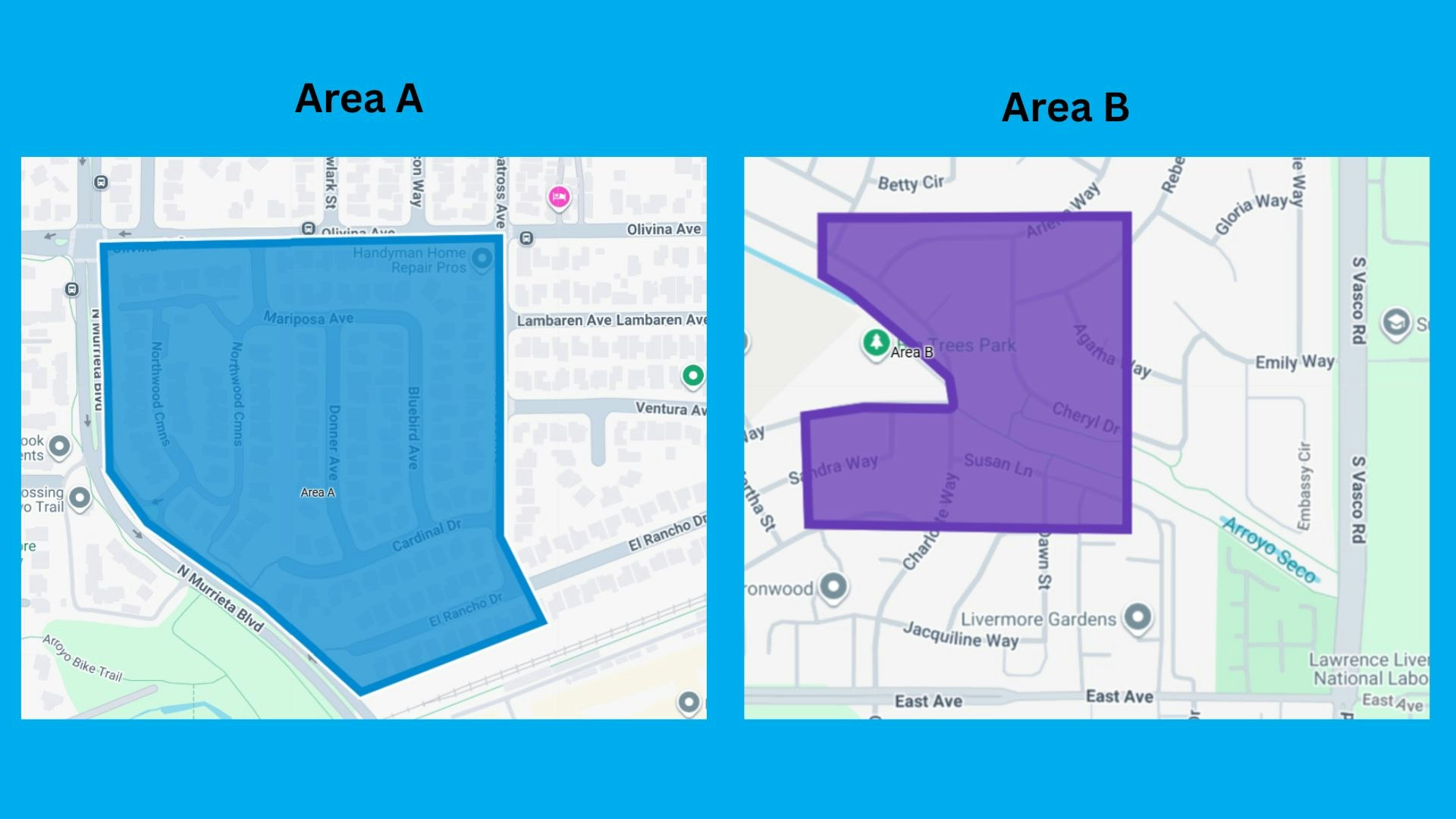
See the maps below for the approximate areas being considered for this innovative mosquito reduction program. Both areas will be evaluated based on Aedes aegypti mosquito abundance data and operational considerations. The final area will be selected in early July. Residents can sign up on the District website to be notified of the selected area.
To learn more about Wolbachia and ACMAD's innovative mosquito reduction efforts, visit: https://www.mosquitoes.org/innovative-mosquito-reduction-in-alameda-county
There are two potential areas for the WB1 male release in Livermore, one in Area A in West Livermore (between N. Murrieta, Olivina Ave, Albatross Ave and El Rancho Dr.) and one in Area B in East Livermore (Along Charlotte Way and Cheryl Way ending a few blocks before S Vasco Rd and East Ave.)
Media Contact
Judith Pierce, MPH
Public Education Officer
510-783-7744